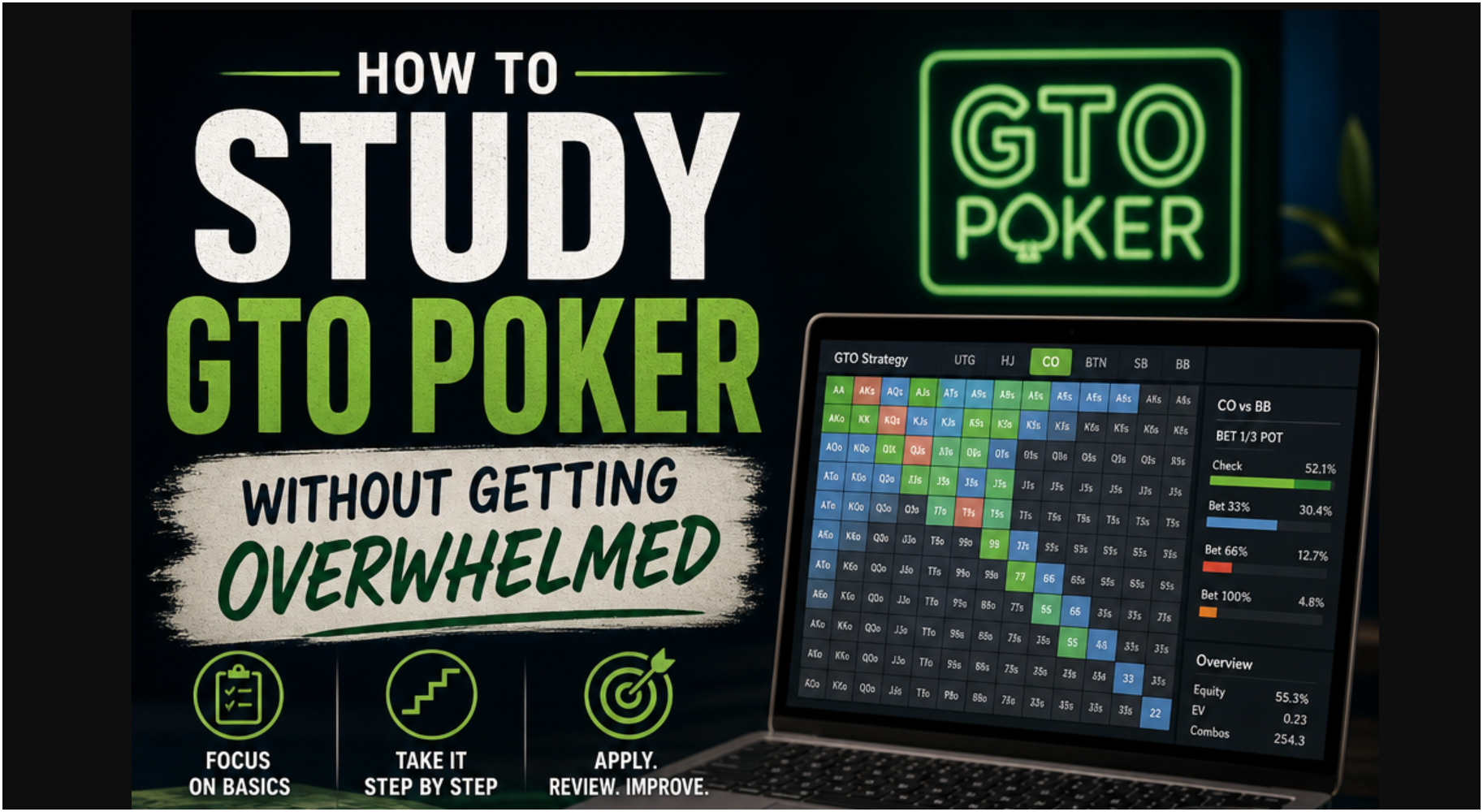
GTO Poker: How to Study Without Getting Overwhelmed
Studying GTO Poker can feel intimidating at first. The charts are dense, the terminology is technical, and every spot seems to come with a dozen possible lines. It is easy to feel like you need to master everything at once before you can even begin improving.
The good news is that you do not need to study GTO Poker in a huge, complicated way. In fact, the best results usually come from a simple, structured approach. If you focus on the right spots, build habits gradually, and avoid trying to memorize every solver output, you can make real progress without burnout.
Start With the Big Picture
One of the biggest mistakes players make is jumping straight into advanced solver reports. That is like trying to learn a language by reading a legal contract.
Instead, start with the basic purpose of GTO Poker:
- Protecting your range
- Making yourself harder to exploit
- Understanding why certain hands bet, call, or check
- Learning common patterns in different board textures
You do not need to understand every mixed strategy right away. At the beginning, it is enough to know what the solver is trying to accomplish in a spot. Once you understand the goal, the details become much easier to absorb.
If you want a stronger foundation before diving deeper, it helps to revisit the broader principles in Understanding the Concept of Game Theory Optimal Poker. That kind of overview makes the rest of your study feel less random.
It also helps to remember that strong fundamentals carry over across formats. Whether you play cash games, tournaments, or short-handed tables, the main idea is the same: learn the logic behind the strategy before worrying about exact frequencies. That mindset makes GTO Poker easier to absorb and easier to apply later.
When you study from the big picture first, you also start recognizing why some hands belong in a betting range while others belong in a checking range. Those broad patterns are far more useful early on than memorizing a long list of exceptions.
Focus on Common Spots First
If you try to study every possible situation, you will quickly get overwhelmed. A better approach is to narrow your attention to the spots that come up most often.
Start with:
Preflop ranges
Learn basic opening ranges, 3-bet ranges, and defending ranges from common positions.
Single-raised pots
These situations happen constantly and are easier to study than complex multiway pots. If you later want to understand how strategy shifts when more players are involved, GTO Poker and Multi-Way Pots: Maximizing Profit in Complex Situations is a useful next step.
Common flop textures
For example:
- High-card dry boards
- Low connected boards
- Paired boards
- Monotone boards
By focusing on these foundational spots, you build a framework that applies to many hands. This makes your GTO Poker study more practical and less random.
A helpful way to prioritize is to ask which spots appear most often in your own games. If you play mostly low-stakes cash games, you may see many single-raised pots and simple continuation-bet decisions. If you play tournaments, you may spend more time on stack-depth pressure and preflop resteal spots. Either way, the goal is to study the most relevant situations first.
Once you understand the common spots, you can begin comparing similar boards and noticing why the solver changes its strategy. For example, one ace-high board may favor small bets while another may prefer more checking because of how the ranges connect. That kind of comparison builds intuition much faster than isolated memorization.
Learn One Concept at a Time
Another way to avoid overload is to study only one concept per session. Do not try to master c-bets, turn probes, check-raises, and river overbets all in the same day.
Instead, pick one topic and go deep enough to understand it clearly.
Examples of useful study themes:
- Why we use range advantage
- When small c-bets work well
- How nut advantage changes strategy
- What makes a good bluff candidate
- Why some boards favor checking
This method works because your brain has time to process and connect the ideas. Small lessons add up faster than scattered, unfocused study.
A helpful way to stay organized is to pair your theory work with a repeatable training resource such as GTO Wizard’s poker training tools and solver resources. A structured interface can make it easier to study one concept at a time instead of trying to decode everything manually.
To make this even easier, keep a short list of “today’s concept” notes. For example, one session might focus only on flop c-bets in position, while another might focus only on turn barrel logic. That keeps your attention narrow and makes each session more productive.
When you study in small units, the learning sticks better. You are not just looking at what the solver does; you are learning why it does it. That difference matters because it turns random information into usable knowledge.
Use Simple Notes, Not Huge Charts
Many players think studying GTO Poker means memorizing solver outputs line by line. That is rarely necessary.
A much better method is to turn solver work into short, useful notes. For example:
- On dry ace-high boards, small continuation bets are common
- On low connected boards, checking more often protects range
- Strong draws can be aggressive bluff-raise candidates
- Weak offsuit hands often prefer folding preflop
These notes are easy to review later and much more useful during real play. You are building principles, not just copying frequencies.
It also helps to format notes by situation instead of by hand class alone. For example, write down what changes when stacks are shallow, when you are in position, or when the board heavily favors one range. That way, the concepts are easier to recall during a session.
Try keeping each note short enough that you can read it in a few seconds. If the note feels too complicated, simplify it further until it captures one clear idea. The goal is not to reproduce the solver output perfectly; the goal is to remember the strategic lesson behind it.
Simple notes are especially valuable when you review multiple spots over time. A compact summary lets you compare board types, stack depths, and positions without getting lost in a pile of data. Over time, those notes become a personal study guide that reflects the hands you actually play.
Review Hands From Your Own Play
Solver study becomes much more powerful when it is tied to your own hands. If you only study theory in isolation, it is easy to forget what matters during a session.
After playing, review a few hands and ask:
- What was the most important decision point?
- What would GTO Poker suggest in this spot?
- Did I choose an action that was logically consistent?
- Was I reacting to the board, stack depth, or player pool?
This kind of review keeps your study grounded in real situations. It also helps you notice patterns in your leaks, which makes your practice more efficient.
To make review sessions more effective, write down the street where the hand became difficult, the range assumptions you made, and the one factor that changed the decision. That simple structure turns a messy hand history into a learning opportunity.
You can also compare your line with the broader strategic ideas in a post like How GTO Wizard can help improve your poker game if you are using software to check your work and spot recurring mistakes.
Hand review becomes even more useful when you sort hands by theme. For example, group together all of your tricky flop decisions or all of your river bluff-catchers. Patterns appear faster when you review similar spots side by side, and that makes it easier to see where your strategy needs the most work.
If you only have time for a few hands after each session, focus on the biggest pots or the spots where you felt least confident. Those hands usually contain the most valuable lessons. One well-reviewed hand can reveal more than a long session of unfocused note-taking.
Don’t Try to Play Perfect GTO
A major source of stress comes from the belief that you must play exact GTO Poker in every hand. That mindset is unrealistic and usually unhelpful.
GTO is a guide, not a cage. The point is to understand strong baseline strategy so you can make better decisions. In real games, you will still adjust based on opponent tendencies, stack sizes, table dynamics, and format.
Think of GTO as the foundation. Exploitative adjustments are the walls and windows. You need both, but the foundation comes first.
This balance is especially important in real money games, where population tendencies often create clear deviations from solver outputs. If you understand the baseline well, you can adjust with confidence instead of guessing. For a deeper look at that balance, see What’s the Difference? Exploitative vs. GTO Poker.
That mindset keeps study from becoming rigid. You are not trying to memorize a robot’s playbook. You are learning how strong strategy works so you can respond intelligently when the game changes.
It also helps to accept that perfect play is not the goal in real time. In an actual session, you will have limited time, incomplete information, and pressure from the action. GTO Poker gives you a strong baseline, but your practical objective is to make the best decision available with the information you have.
That perspective reduces stress and makes study more sustainable. Instead of feeling like every deviation is a failure, you can view each session as a chance to refine your understanding and improve your decision-making process.
Build a Simple Weekly Routine
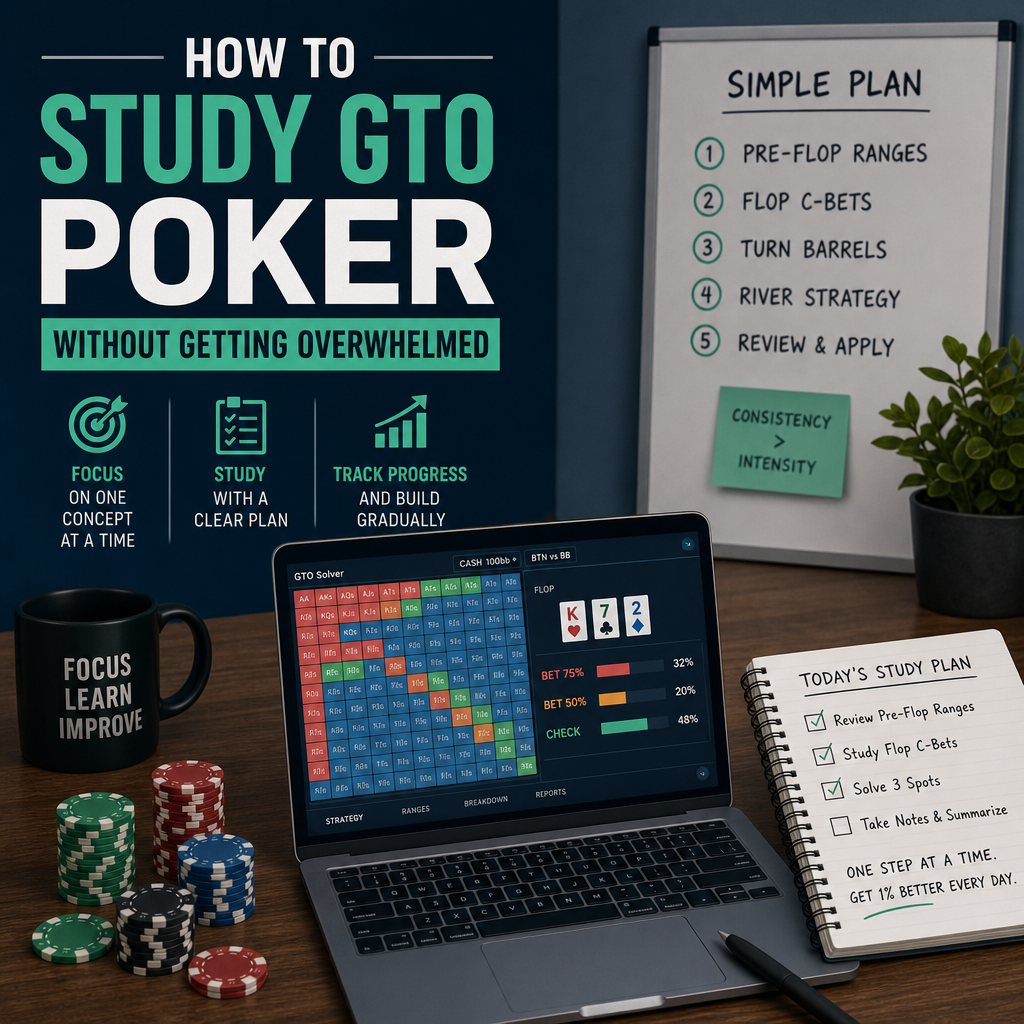
Consistency matters more than intensity. A short, repeatable study routine is usually better than one exhausting marathon session.
A simple weekly structure might look like this:
- Day 1: Review preflop ranges
- Day 2: Study one flop texture
- Day 3: Review hands from your own play
- Day 4: Focus on one turn or river concept
- Day 5: Revisit notes and quiz yourself
Even 20 to 30 minutes per session can be enough if you stay focused. The goal is steady improvement, not information overload.
Some players also benefit from linking study blocks to a specific format. For example, if you mostly play six-max cash games, it makes sense to keep your study centered on common six-handed situations rather than trying to cover every possible format at once. A dedicated resource like 6 Max Poker GTO Strategy can help keep your practice aligned with the games you actually play.
If you have a more visual learning style, it can help to assign one topic per day and keep the session short enough that you can finish with mental energy left. That makes it much easier to return the next day instead of dreading the work.
You can also build a routine around review and repetition. Read your notes, test yourself on the main idea, and then compare your answer to the solver output or your study material. That cycle of recall and correction is one of the fastest ways to turn knowledge into instinct.
A routine does not need to be complicated to work. The most important thing is that it is realistic enough for you to repeat. A simple schedule that you can maintain for months will produce better results than a perfect plan you abandon after a week.
Keep Your Study Practical
Whenever possible, ask yourself how a concept affects real decisions. This keeps your GTO Poker study from becoming abstract.
For example:
- If I open from the cutoff, what hands can I continue against a 3-bet?
- If I check this board, what hands am I protecting?
- If the turn changes nothing, do I keep betting small or slow down?
- Which bluffs make sense because they block strong hands?
Practical questions make theory easier to remember because they connect directly to action.
You can also improve retention by explaining the concept out loud in simple language. If you can describe why a line works without using solver jargon, you probably understand it well enough to use in real play.
Another useful habit is to compare your study spots with real hands from your database. If the same board type keeps appearing in tough spots, make that texture the focus of your next session. That is how study stays relevant and how progress becomes measurable.
Practical study also helps you separate what matters from what is merely interesting. Not every solver detail deserves equal attention. Some spots occur often and have a big impact on your win rate, while others are rare or highly specific. Spending more time on the former gives you a much better return on your study time.
The best questions are the ones that point directly to action. Ask what range you are representing, what your opponent is likely doing, and which hands gain or lose value when the board changes. That keeps the work grounded in decisions rather than theory for theory’s sake.
Advanced Study With GTO Poker
Once the basics feel comfortable, you can begin to study more advanced layers without getting lost. This is where GTO Poker becomes even more valuable, because the framework you built earlier helps you interpret the details.
At this stage, it can be useful to look at:
- Bet sizing differences across board textures
- How position changes range construction
- Which turns create new barreling opportunities
- How river blockers influence bluffing choices
- Why some hands mix between betting and checking
The key is to keep the same disciplined approach: one topic, one texture, one takeaway. The more advanced the material becomes, the more important it is to stay organized.
If you are studying heads-up or short-handed play, you may also find that the available ranges become wider and the strategic pressure increases. A focused guide like Game Theory Optimal Poker Heads Up Strategy can help you understand how those ideas translate into a more specific format.
Advanced study does not mean abandoning the basics. In fact, the strongest players usually revisit fundamentals often. They just apply those fundamentals to more difficult and more realistic situations.
As your understanding grows, you will notice that the same ideas repeat across different spots. Range advantage, nut advantage, board texture, and position all keep showing up. That repetition is a sign that the system is starting to make sense, and it is one of the clearest signs that your study is working.
Final Thoughts
Studying GTO Poker does not have to be overwhelming. The key is to simplify the process, focus on high-frequency spots, and build understanding step by step. Learn the purpose behind the strategy, study one concept at a time, and use your own hands to reinforce what you learn.
If you stay consistent and keep your study practical, GTO Poker becomes much less intimidating—and much more useful at the table.
The best players are not the ones who try to memorize everything. They are the ones who understand the framework, apply it in the right spots, and keep refining their process over time.
When you treat study as a gradual process instead of a race, you give yourself room to improve without frustration. That approach makes it easier to stay consistent, and consistency is what turns theory into real results.
One of the simplest ways to keep progress moving is to revisit the same core concepts often enough that they become familiar. That repetition is what makes GTO Poker feel less like a puzzle and more like a set of practical decision rules you can use with confidence.
Over time, the aim is not to know every solver branch. The aim is to recognize the most important strategic patterns quickly, trust your process, and make better decisions in the hands that matter most.