Table of Contents
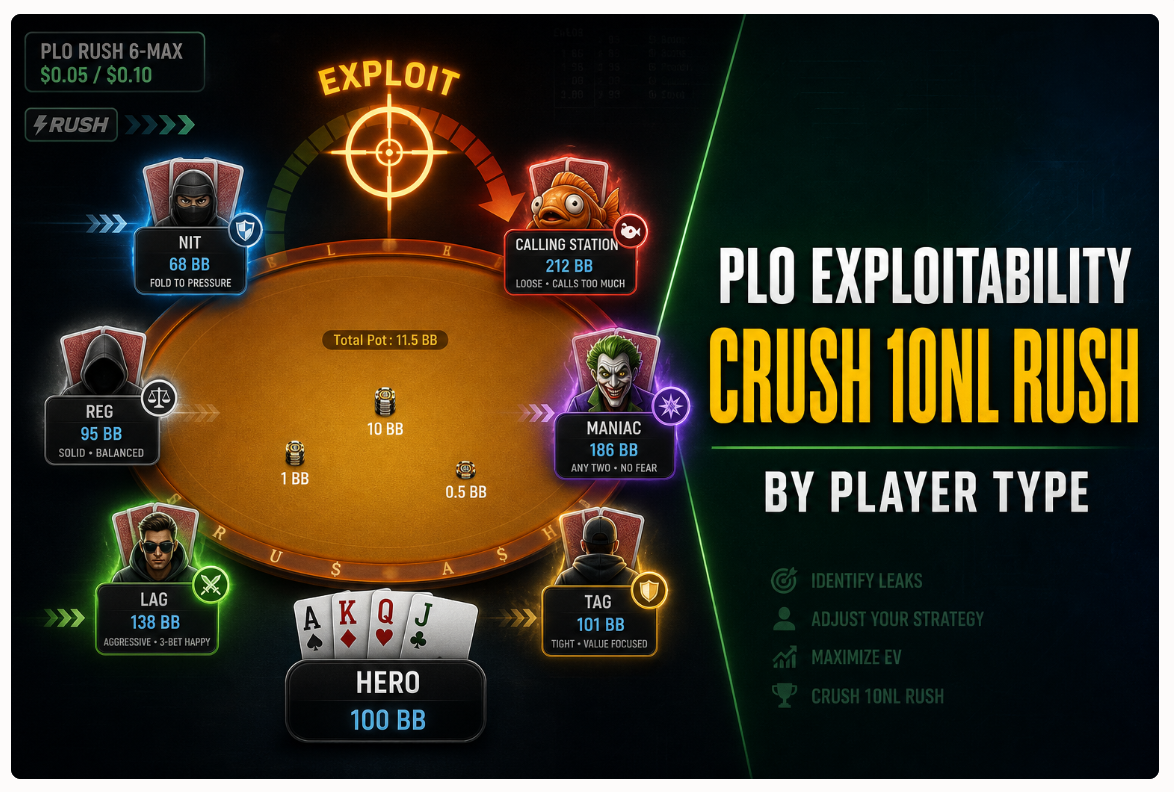
PLO Exploitability Masterclass: How to Crush 10NL Rush 6-Max by Player Type
Most players grinding 10NL Pot-Limit Omaha on GGPoker Rush 6-Max are still trying to solve the game. They're running sims, studying equilibrium play, and obsessing over solver outputs — while sitting in pools that are frankly not close to GTO. At this level, exploitability is not a weakness in your game. It is your edge.
The players you face every day are not random noise. They fall into recognisable, repeatable patterns. A calling station doesn't suddenly start folding rivers. A nit doesn't start bluffing the turn. A LAG doesn't tighten up when you 3-bet him. If you can classify a player quickly using your HUD stats and apply a pre-loaded exploit strategy, you will extract far more EV than any solver session at 10NL.
This post lays out the complete 10-type PLO player classification system used in the GTOCharts.com player profiling tool — built from tracking 33+ real players at 10NL Rush 6-Max on GGPoker. You'll learn how to read the key HUD stats (especially the VPIP/PFR gap, which is criminally underused), how to respond to 3-bets by player type, how to adjust for stack depth, and how to execute the most important exploits at this level.
If you're playing with a Smart HUD on GGPoker, this framework plugs straight in. Let's get into it.
The 10-Type PLO Player Classification System for 10NL PLO Rush Exploit
This system classifies every opponent you'll encounter at 10NL Rush 6-Max into one of ten distinct player types, each with a colour code that maps to a real HUD colour profile. The six key stats are VPIP, PFR, ATS (Attempt to Steal), 3-Bet%, and the derived Gap (VPIP minus PFR). Each type has a clearly defined primary exploit — the highest-EV default adjustment you can make against that player.
| Colour | Type | VPIP Range | PFR | ATS | 3-Bet% | Gap | Primary Exploit |
|---|---|---|---|---|---|---|---|
| ● Red | LAG Reg | 20–28% | 15–20% | 35–45% | 7–10% | 5–9% | 4-bet premiums. Defend blinds wide. |
| ● Orange | Solid TAG | 17–26% | 13–18% | 25–38% | 2–6% | 3–9% | 3-bet IP. Attack flat-call range. |
| ● Yellow | Cautious Reg | 14–24% | 10–16% | 18–27% | 3–5% | 8–12% | Steal every blind. 3-bet his opens. |
| ● Lime | Nit | 10–15% | 3–8% | 5–12% | 1–2% | 5–10% | Steal constantly. Fold to all raises. |
| ● Green | Calling Station | 30–50% | 8–15% | 15–30% | 1–3% | 15–35% | Value-bet every street. Never bluff. |
| ● Cyan | Aggro Good | 20–28% | 16–22% | 35–50% | 5–9% | 4–8% | Trap OOP. 4-bet premiums. |
| ● Blue | Trapper | 15–22% | 3–8% | 6–12% | 1–2% | 10–18% | Fold to all raises. Iso limps. |
| ● Brown | Maniac | 28–70% | 18–45% | 35–68% | 5–12% | 10–25% | Flat IP. Call down wide. Never bluff. |
| ● Purple | GTO Apprentice | 22–30% | 18–26% | 38–55% | 8–14% | 4–8% | Call down wider. Raise turns. |
| ● Pink | Loose-Passive Fish | 25–50% | 5–15% | 15–30% | 0–3% | 15–40% | Iso every limp. Value all streets. |
Keep this table open while you play. Within 20–30 hands on any Rush seat, you'll have enough data to slot a player into one of these types and switch on the appropriate exploit. The goal is not perfect precision — it's having a directionally correct exploit running as early as possible.
The VPIP/PFR Gap — The Most Underrated HUD Stat in PLO
In No-Limit Hold'em, the VPIP/PFR gap is a useful secondary stat. In PLO, it is arguably the single most important piece of information on your HUD. Here's why.
PLO hands connect with boards far more frequently than NLHE hands. When a player enters a pot by calling rather than raising, they are bringing a wide, unprotected range to a game where board interactions are dense and postflop decisions are complex. A large gap doesn't just signal passivity — it signals postflop vulnerability. Players with big gaps tend to have:
- Capped ranges (their raises tend to be premiums only, their calls are wide and speculative)
- Poor fold equity as aggressors (they can't credibly represent strong hands in their limp/call range)
- Difficulty generating bluffs on later streets (they don't build pots pre, so they're often pot-committed with weak made hands)
- A tendency to chase draws and get stuck in large pots with second-best hands
Here's how to read the gap in practice:
- Gap <5%: Disciplined player. Almost everything they play is raised. Their range is tight and predictable. Treat them as strong and proceed carefully.
- Gap 5–10%: Moderate cold-calling. Some speculative hands enter unraised. Still broadly competent. You have edges but they're not massive.
- Gap 10–15%: Significant passive entries. Their calling range is wide and not well-protected postflop. Probe turns, valuebet wide, and don't back down.
- Gap 15%+: This player is a fish regardless of their VPIP. Even a player with VPIP 30 and PFR 10 is bringing a massive limp/call range to every pot. They are never well-protected. They are rarely bluffing. They are almost always paying you off with worse. Iso-raise them every time.
The gap is the first number you should check when a new player appears in your HUD. It tells you more about how to adjust than VPIP or PFR alone.
Deep Dive: The 3 Most Common Types You'll Face
Based on 33+ tracked players at 10NL Rush 6-Max on GGPoker, three player types dominate the pool. Here's how to systematically exploit each one.
● Loose-Passive Fish (Pink) — The Bread and Butter
The Pink player is your primary source of EV at 10NL. They are in the pot constantly but rarely driving the action. They call pre, call flop, call turn, and then either shove river with a made hand or fold when they've bricked out. Their 3-bet frequency is near zero, which means their raising range at any point in the hand is extremely polarised toward the near-nuts.
Isolation: Never let a Pink player limp into a multiway pot cheaply. Iso-raise to 4–5x (or more in position) every single time. You want to play large, heads-up pots in position against a capped, passive range. If you're out of position, you can still iso from the blinds but be more selective — lean toward hands with strong nut potential rather than speculative rundowns.
Postflop value-betting: Widen your value range against Pink players significantly. Hands you'd check back against a competent player — top two pair with a weak kicker, a bare nut flush — become mandatory bets here. Bet every street you have any advantage. Go large. They will call with second pair and a gutshot. They are not thinking about your range — they are thinking about their own hand.
Never bluff: This is non-negotiable. Pink players do not fold made hands of any strength. If they've called two streets, they are not folding the river. A pot-sized river bluff into a calling station is one of the most expensive leaks at 10NL. Do not do it. Channel every bluffing instinct you have into semi-bluffs with equity, never bare bluffs.
Facing a raise: When a Pink player raises — preflop or postflop — give them enormous credit. Their raising range is the near-nuts. Unless you have the nuts or a massive draw with equity, fold or proceed extremely carefully.
● Solid TAG (Orange) — The Bread-and-Butter Regular
The Orange player is the most common player type in the pool — roughly 35% of all tracked players at this level. They have solid fundamentals, play a reasonable range, and are broadly competent. But they have a key structural weakness: a capped flat-call range.
Because their 3-bet frequency is only 2–6%, the hands they flat preflop are capped. They're not slowplaying AAKK or AAQQ — those go into their 3-bet range. Their flat range is full of rundowns, suited aces, and medium-strength holdings. This creates significant exploits.
3-bet in position: When you have position on an Orange player and they open, 3-bet them liberally with strong hands. They will often flat or fold. When they flat, you are playing a 3-bet pot in position against a capped range — ideal conditions for continuation betting on most boards.
Attack their flat-call range postflop: When an Orange player flats pre and checks to you, probe. Their range is full of medium-strength holdings that struggle on many board textures. A half-to-three-quarter pot bet on the flop, followed by a turn probe when they check again, will take down a lot of pots uncontested.
Probe turns aggressively: Orange players tend to be straightforward in the sense that they check their weak holdings and bet their strong ones. When they check the flop and you check back with a medium holding, come back with a turn probe. They will often give up second-best hands here.
Respect their value range: When an Orange player leads for a big bet or raises, you are generally behind. They don't bluff enough to make calling down with second-best holdings profitable. Credit their aggression and fold medium-strength hands.
● Cautious Reg (Yellow) — The Exploitable Tight Player
The Yellow player is fundamentally a tighter, more passive version of the Orange. Their VPIP runs between 14–24% and their ATS is notably low — 18–27%. That low steal frequency is the tell. They are not attacking the blinds enough, which means they are ceding free equity constantly.
Steal every blind: Every time a Yellow player is in the big or small blind, attack from the cutoff, button, and small blind with your full stealing range. They will fold far more than the theoretically correct amount. Over hundreds of hands, this alone is a meaningful EV edge.
3-bet their opens: Yellow players open a tighter range than their VPIP suggests. When they do open, 3-bet them from position. Their low 3-bet frequency means their flatting range is also capped — and their response to aggression tends to be passive (call or fold, rarely 4-bet).
River value-bet sizing: Yellow players are more likely than fish to fold the river to over-bets. But they also call down more than they should with medium-strength holdings on straightforward board textures. Exploit this by betting larger for value on rivers where your hand is clear and the board hasn't changed the dynamic. A pot-size river bet will get called by their strong two-pair and flush hands — hands they won't fold regardless of sizing. Save the smaller sizing for thin value spots where you want to induce a call from a wider range.
How to Respond to 3-Bets by Player Type
One of the most common mistakes at 10NL is applying a uniform response to 3-bets. The correct response depends entirely on who is 3-betting you and how often they do it. Here is the complete cheat-sheet by player type.
| Player Type | Their 3-Bet% | IP Response | OOP Response |
|---|---|---|---|
| ● LAG Reg | 7–10% | 4-bet premiums, flat rundowns | 4-bet premiums, fold rest |
| ● Solid TAG | 2–6% | 4-bet premiums, flat tight | 4-bet premiums, fold non-premiums |
| ● Cautious Reg | 3–5% | 4-bet premiums only | Fold everything |
| ● Nit | 1–2% | Fold everything but AA | Fold immediately |
| ● Calling Station | 1–3% | Fold everything but AA | Fold immediately |
| ● Aggro Good | 5–9% | 4-bet premiums, flat IP | 4-bet premiums |
| ● Trapper | 1% | Fold everything | Fold immediately |
| ● Maniac | 5–12% | 4-bet premiums, flat wide IP | 4-bet or flat with equity |
| ● GTO Apprentice | 8–14% | 4-bet + flat wide | 4-bet + flat selectively |
| ● Fish | 0–2% | Fold immediately | Fold immediately |
A few key principles to understand this table:
- Low 3-bet frequency = near-nuts only. When a Nit, Trapper, or Fish 3-bets you, they have it. Do not bluff-catch. Do not call with second-best hands. The EV of continuing is negative against a range this strong, even with position.
- High 3-bet frequency = more bluffs, more calls profitable. Against a GTO Apprentice or Maniac 3-betting at 8–14%, their range is wide enough that strong rundowns and double-suited hands have profitable calls in position. You can also profitably 4-bet a wider premium range because they will call with dominated hands.
- OOP responses should always be tighter. The position discount is huge in PLO. Hands that are profitable 4-bets in position become marginal or losing calls out of position. When in doubt, add one tier of tightening to any OOP response.
Stack Depth Adjustments
At 10NL Rush, effective stack depths vary from short-stackers running 40–60bb to deep-stackers playing 150bb+. The three most common player types — Pink Fish, Orange TAG, and Brown Maniac — each require specific stack depth adjustments.
Loose-Passive Fish (Pink)
Shallow (40–70bb): Iso-raise smaller (2.5–3x) to preserve SPR for postflop play. Your edge comes from value-betting, and a lower SPR means you reach all-in earlier with your top hands. Good. Bet/call all-in with top two pair or better on most boards.
Deep (100–150bb): Iso-raise larger (4–5x) to build pot and create better value on later streets. With deep stacks, your nut hands are worth more because Pink players will stack off with worse holdings. The deeper the stacks, the more you want to isolate and play large pots against them.
Solid TAG (Orange)
Shallow (40–70bb): Reduce 3-bet bluffing frequency. With less room to manoeuvre, Orange players are more likely to commit with medium-strength holdings. Stick to value 3-bets with your premium hands and give more respect to their postflop bets at shallow depth.
Deep (100–150bb): This is where attacking their flat-call range becomes even more powerful. With deep stacks, their capped range is under-realised — they can't stack off with second-best hands and survive. Probe turns and rivers more aggressively and apply maximum pressure with your strong hands.
Maniac (Brown)
Shallow (40–70bb): Be cautious about flatting in position with speculative hands. At shallow depth, Maniacs will shove a wide range on the flop or turn and deny your equity. Favour hands with strong made-hand potential over pure draw combos.
Deep (100–150bb): This is the ideal situation against a Maniac. Deep stacks amplify their aggression-driven mistakes. Flat in position with strong hands, let them build the pot, and call down. Your patience gets paid off at a much higher multiplier. Never bluff them — they will never fold.
Real Pool Data: What 10NL Rush Actually Looks Like
This framework wasn't built in a vacuum. The 10-type system was developed by analysing real players at 10NL Rush 6-Max on GGPoker over hundreds of tracked sessions.
Pool Insight: Over 33 players tracked at 10NL Rush GGPoker, the most common player type was Orange (Solid TAG) at approximately 35% of the pool, followed by Pink (Loose-Passive Fish) at approximately 25%. Together, these two types account for more than half of all opponents you'll face. Mastering just these two exploits will have a significant impact on your win rate.
The third most common type was Yellow (Cautious Reg) at around 12–15%, with Brown Maniacs appearing at roughly 8–10% — less frequent, but disproportionately high-variance when they do show up.
The rarest types were Purple (GTO Apprentice) and Cyan (Aggro Good), which each appeared in fewer than 5% of tracked players. At 10NL, the pool simply isn't populated by many players who have done serious solver work. When you do encounter them, recognise that the dynamics shift — you're playing a more balanced game and should reduce your exploitative deviations accordingly.
The practical takeaway: build your default exploits around Orange, Pink, and Yellow. These three types alone cover over 60% of the player pool. If you have clear, automatic reads and responses for each, you will outperform the average 10NL player significantly.
Quick Reference Cheat Sheet
| Situation | Player Types | Rule |
|---|---|---|
| Always steal blinds | ● Lime ● Yellow ● Blue |
ATS under 25% — they give up far too often. Attack every orbit. |
| Always iso-raise limpers | ● Pink ● Green ● Blue |
Gap 15%+ or habitual limpers. Iso every single time, especially IP. |
| Never bluff | ● Pink ● Green ● Brown |
These players do not fold made hands. Every bluff is burning chips. |
| Fold to 3-bets (near-nuts only) | ● Nit ● Trapper ● Fish ● Station |
3-bet frequency 1–3%. Their range is the near-nuts. Fold unless you have AA or equivalent. |
| 4-bet freely | ● LAG ● Maniac ● GTO Apprentice |
3-bet frequency 7–14%. They have bluffs in range. 4-bet premiums and selected strong rundowns. |
Print this. Screenshot it. Paste it next to your HUD. The goal is to make these decisions automatic — not a calculation, but a reflex. When you see a player with VPIP 38 and PFR 9, you should be reaching for the iso-raise button before you've consciously thought about it.
Putting It Together: A Session Workflow
Here is a practical session workflow for applying this system at 10NL Rush 6-Max:
- First 15–20 hands: Observe. Note VPIP, PFR, and gap. Don't try to classify too early — preliminary reads can mislead. Play straightforward poker in the meantime.
- By 25–30 hands: You should have a working classification. Slot them into the system and switch on the primary exploit. Don't overthink it — directional accuracy is enough.
- Update dynamically: If a player who looked like Orange starts limp-calling hands, update their gap estimate and shift your read toward Yellow or Pink. Stats in Rush are small-sample — stay flexible.
- Maintain a note or tag: Even a simple colour tag in your HUD for recurring players you've seen across sessions accelerates your read time dramatically.
- After the session: Review the 3–5 largest pots. Ask: did I apply the right exploit for the player type? If you lost a big pot bluffing a Pink, that's a systems failure, not bad luck.
The most important habit is systematic classification before exploit execution. Jumping straight to exploitation without classifying first is how you end up bluffing calling stations or folding too much to nitty limpers. The classification is the engine. The exploit is the output.
The Best PLO Tools for Exploitative Study
Understanding player types is only half the equation. To actually drill exploitative responses, refine your preflop ranges, and pressure-test your lines against solver output, you need the right tools. Here are the three that complement this framework best.
PLO Ninja
Best for: preflop range drilling
PLO Ninja 6 Max *Free Version
*The Free Version has all the basic functionality of the Paid Version, except the only position you can select is UNDER THE GUN. This allows you to thoroughly test the products core features and evaluate its accuracy without any upfront cost.
You can explore the interface, run simulations, and assess the reliability of the results from the UNDER THE GUN position.
By experiencing the Free Version firsthand, you can make an informed decision about upgrading to the Paid Version for access to all positions and advanced features.

PLO Genius
Best for: node-locking & exploit generation
PLO Genius is a cloud-based GTO solver covering both preflop and postflop for PLO4 and PLO5. What makes it uniquely powerful for exploitative play is node-locking — you can manually override an opponent's strategy at any decision point to reflect their real tendencies (e.g. a Loose-Passive Fish who never folds the flop), and the solver auto-generates the optimal counter-strategy. It also has built-in exploit presets in the sim selector, and it's rake-aware. This is the tool you want when you need to go deep on how to maximally punish a specific player type on a specific board texture.

FlopHero
Best for: instant in-session spot analysis
FlopHero combines a solver, tracker, and hand simulator in a single cloud platform. The key advantage is speed — instant hand analysis without setting up trees from scratch. At $60/month for mid-stakes (up to PLO500) it's priced for the serious player. FlopHero is ideal when you finish a session and want to quickly identify which spots you misplayed against a specific opponent type — drop in a hand, see the deviation, and know exactly where the exploit was or wasn't taken. Think of it as the forensic tool: where PLO Genius lets you build exploit strategies from scratch, FlopHero lets you audit whether you executed them.

Used together, these three tools cover the full study loop: drill preflop ranges (PLO Ninja) → build opponent-specific exploit strategies (PLO Genius) → review session hands and identify missed spots (FlopHero). That's a complete exploitative edge-building workflow for any serious 10NL+ grinder.
Conclusion: Stop Playing GTO Against Players Who Aren't
At 10NL Rush 6-Max, the EV gap between a solid exploitative strategy and a balanced GTO approach is significant. Your opponents are not solvers. They are human beings with patterns, tendencies, and predictable leaks. The player who can identify those patterns quickly and apply the right response automatically — without variance, without overthinking — will beat this game.
The 10-type classification system is a tool for systematising that process. Combine it with your Smart HUD on GGPoker, track your observations, and run the exploits consistently. Over a meaningful sample, the edges compound.
Ready to take this further? GTOCharts.com offers preflop charts built specifically for PLO
Study the system. Know the exploits. Build the reflexes. That's how you beat 10NL.