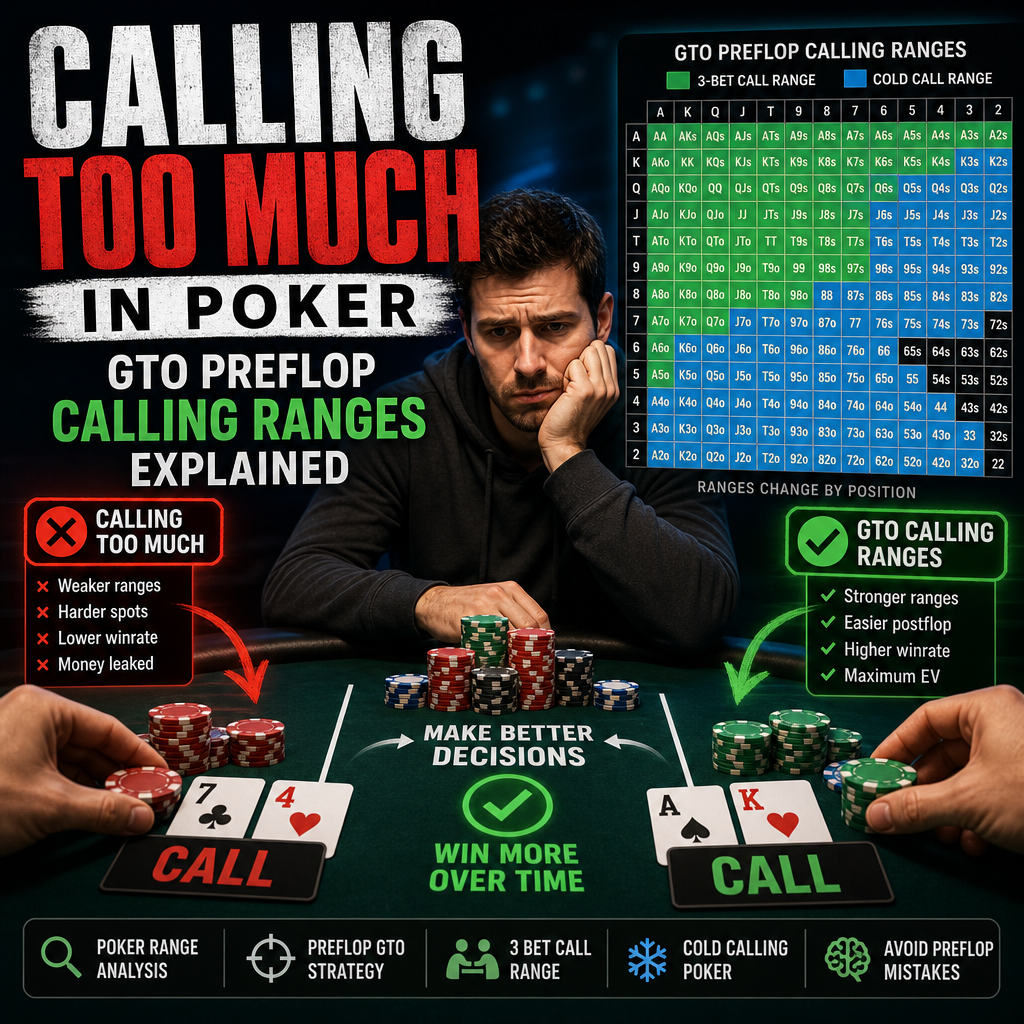
Calling Too Much in Poker: GTO Preflop Calling Ranges Explained
One of the most common poker preflop mistakes is also one of the hardest to notice: calling too much in poker. It feels safe. It keeps pots smaller. It avoids “committing” too early. But from a GTO lens, too many calls create bloated, under-realized ranges that are easy to exploit and difficult to play profitably postflop.
The issue is not just whether a hand is “good enough” to continue. It’s whether your preflop calling ranges preserve range quality, position leverage, and enough strong hands to defend against aggression.
Why You’re Probably Calling Too Much Preflop
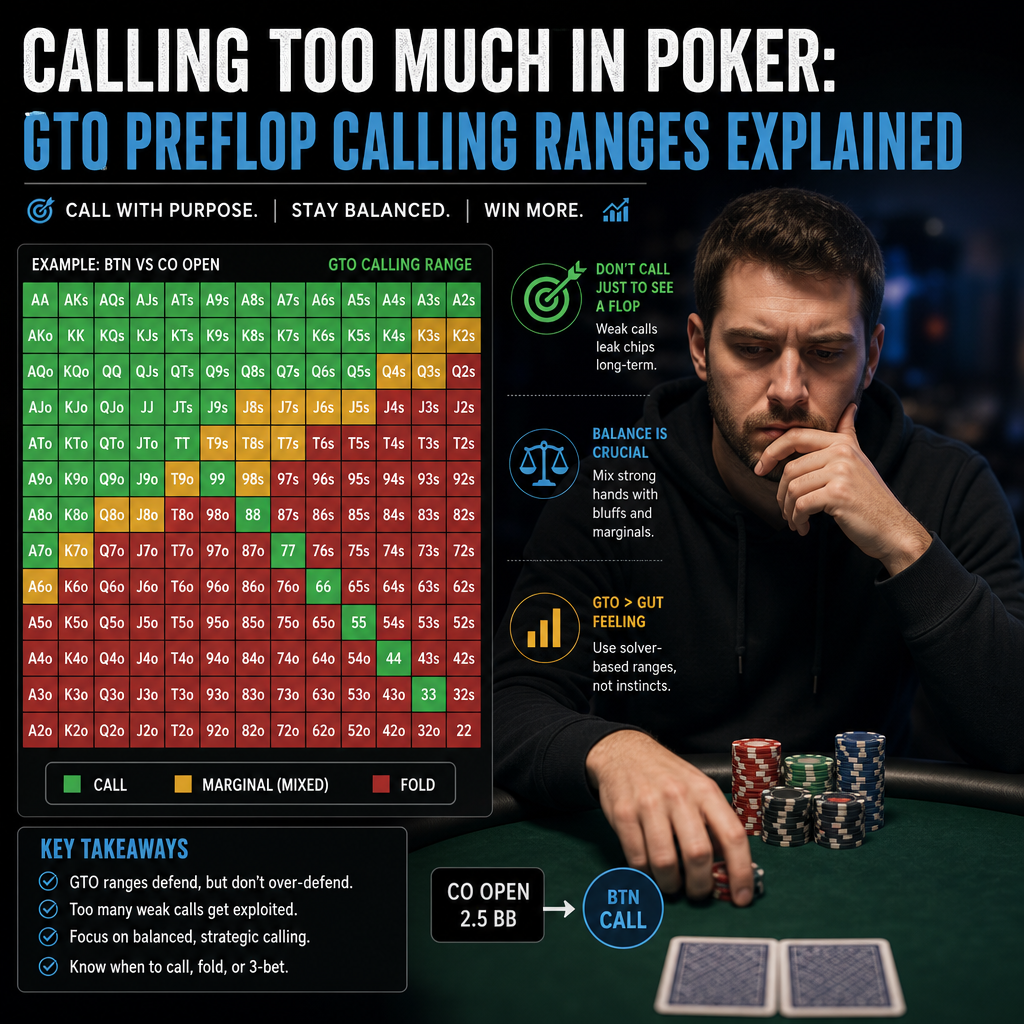
When players start reviewing their preflop decisions, they often discover the same pattern: they are far more willing to continue than they realized. Calling too much in poker usually comes from good intentions. You want to stay flexible, avoid big mistakes, and keep weaker opponents in the pot. The problem is that those calls often weaken your overall range construction.
In modern preflop play, especially in rake-sensitive environments, a loose continue strategy can quietly drag down your win rate. Even when a hand feels playable, it may still be a poor call because it reduces your range’s ability to realize equity and maintain pressure in later streets.
The key idea behind preflop calling ranges is simple: the goal is not to put more hands in the pot. The goal is to choose hands that keep your range structurally strong. That usually means folding more weak offsuit hands, using position more carefully, and preferring combinations that can make strong top pairs, strong draws, and profitable bluff-catchers when the board texture shifts.
When you study a solver output or a solid chart, you’ll notice that the best ranges are not the widest ranges. They are the ranges with the cleanest interaction against the opening range and the best balance between value and realization. That is the part many players miss when they think about calling too much in poker.
The Hidden Problem With Loose Calling
When you call too often preflop, you usually end up with one of three problems:
- Domination: your hand is dominated by stronger versions in villain’s value range
- Poor playability: you miss frequently and realize equity poorly
- Range dilution: your continuing range becomes too capped and too face-up
A lot of players think in hand-strength terms. GTO thinks in range structure. That difference matters.
For example, a hand like A9o might look playable in isolation, but when you cold call or continue too wide, you often put yourself in spots where better aces dominate you, stronger broadways dominate your top pair, and you miss the board more often than you connect.
That is the hidden cost of entering pots with weak range structure. A hand does not need to be terrible to be a losing call; it only needs to be slightly worse than the alternatives often enough. Over thousands of hands, those small losses add up.
To understand why some calls lose value so quickly, it helps to look at how equity distribution changes across a range. The PokerNews strategy resources are a useful reference point for fundamental equity and range concepts.
Once you start comparing equity by combination instead of by broad category, many “automatic” continues stop looking automatic. That is one of the most useful mindset shifts in modern preflop study: stop asking whether a hand is playable and start asking whether it improves the entire continue range.
Cold Calling Poker: Why It Looks Better Than It Is
Cold calling poker is especially tempting because it seems to “trap” ranges or keep weaker players in. In reality, cold calls often create the worst structural problems.
Here’s a simplified comparison of two common spots:
Example: CO opens, BTN action
Tighter GTO-style continue range
- 3-bet: QQ+, AK, A5s-A2s, KQs
- Call: pocket pairs 22-99, suited broadways, suited connectors, some AQ/AJs mixes
- Fold: dominated offsuit hands, weak suited gappers, marginal suited aces
Loose calling version
- Call: most suited aces, weak offsuit broadways, many suited kings, more offsuit connectors
- 3-bet less often
- Fold less overall
The loose version looks active, but it produces a weak distribution of top pairs, second pairs, and strong draws. You end up continuing with hands that struggle to stack off, bluff-catch, or apply pressure. In practice, that means you are often paying rake and entering low-leverage pots with hands that have limited upside.
That’s a big reason GTO calling ranges are narrower and more selective than many players expect. The solver is not trying to keep every marginal hand in the mix. It is trying to maximize long-run EV by choosing the combinations that preserve enough strength across the whole range.
Think about what happens on common flops. If you cold call too wide, you have more weak pairs, more weak draws, and more hands that interact badly with standard continuation-bet sizing. Your opponent gets to pressure a range that misses too often and lacks enough robust continues. That is a structural leak, not just a single bad hand.
Defending Dominated Hands Is Usually the Leak
A major preflop leak is continuing with hands that are “fine” but heavily dominated. This is one of the most costly poker preflop mistakes because these hands make second-best hands too often.
Common examples:
- AJo facing early position strength
- KQo versus tighter opens
- KJo and QJo in many aggressive configurations
- weak suited aces versus strong continuing ranges
These hands can win money, but they often lose big pots and fail to extract enough value when ahead. They look attractive because they make top pair, but when the top pair is frequently dominated, the call starts to lose its appeal quickly.
Quick chart-style comparison
| Hand Type | GTO Preference | Common Leak |
|---|---|---|
| AJo vs tight open | Often mix/fold more than players think | Call too often |
| KQo vs MP open | Sensitive to position and rake | Treat as automatic defend |
| A5s vs aggression | Often stronger as 3-bet candidate | Just call and realize poorly |
| Small suited connectors | More playable in position | Over-call out of position |
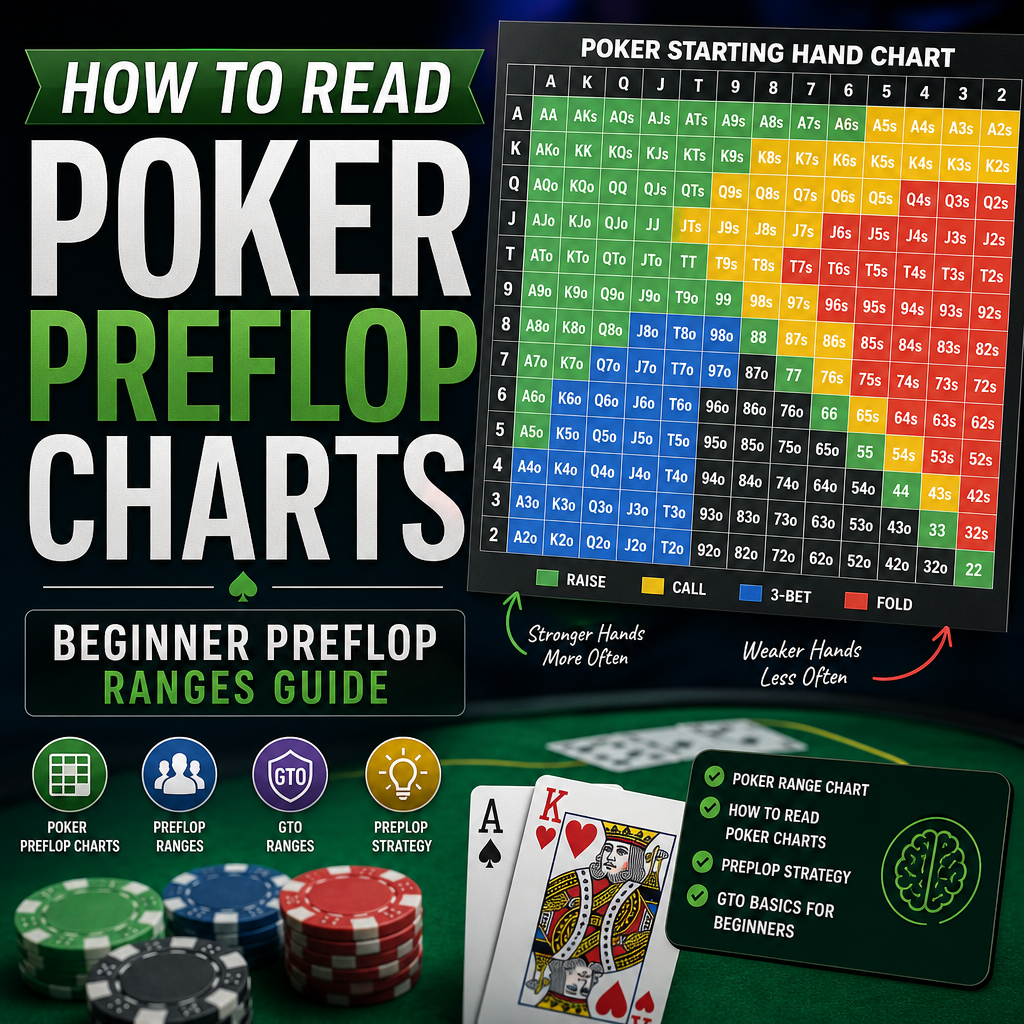
If you want a deeper practical review of how hands change by position, stack depth, and rake, start with Poker Preflop Charts: Beginner Guide to Preflop Ranges. It gives you a cleaner framework for comparing baseline ranges before you start mixing in exploitative adjustments.
When you study these spots, the difference between a decent call and a weak one is often smaller than players expect. That is why a player can be technically close and still lose meaningful EV across thousands of hands. For more exact EV comparisons between close actions, solver output from GTO Wizard is the right place to drill into the details.
In other words, the problem is not always obvious from the result of the hand. A hand can look “fine” after winning a medium pot, but if it should have been folded a large percentage of the time, the call is still part of a broader leak. That is why disciplined study matters more than trying to justify every borderline defend after the fact.
Calling 3-Bets Too Widely
A huge leak in many pools is building an oversized 3 bet call range. Players justify it with implied odds, blocker logic, or “I can outplay them postflop.” Sometimes that’s true. Often, it’s a fantasy.
When you call 3-bets too wide, you usually cap yourself and give the aggressor a structural advantage. Their range contains more premium hands, more strong suited broadways, and better nut density. Your range often becomes too many middling pairs and speculative hands.
Compare these two approaches
Disciplined 3-bet defense
- Continue with strong pocket pairs
- Mix in robust suited broadways
- Use some 4-bets with blockers
- Fold dominated offsuit broadways and weak suited junk
Loose 3-bet defense
- Call nearly any suited hand
- Call too many offsuit broadways
- Defend small pairs in poor conditions
- Hope to “hit a flop”
The second approach inflates your red-line losses and makes postflop decisions harder. Good preflop GTO strategy isn’t about calling frequently. It’s about calling selectively with hands that maintain range integrity and realization.
This is also where adjustment matters. If you want to go beyond baseline theory and look at real pool tendencies, studying Key Strategies to Exploit Winning Players can help you identify when a population is overfolding, overcalling, or simply defending the wrong combinations.
It also helps to remember that some hands perform better as aggressive actions than as passive calls. A blocker-heavy suited ace or a hand with strong equity and playability can often do more work as a 3-bet than as a call. If you default to calling, you may be leaving value on the table in exactly the spots where your range should be more assertive.
Why calling too much in poker hurts range quality
It is easy to think of a call as a low-risk decision, but range quality tells a different story. When you call too much in poker, you often remove the cleaner high-EV folds from your strategy and replace them with hands that play awkwardly against strong ranges. That shift matters because a range is only as useful as its best realizable branches.
The same issue shows up when players defend hands because they are “connected” rather than because they block well or realize equity efficiently. A connected hand can still be a poor continue if it is dominated by the opening range, has weak reverse implied odds, or makes second-best pairs too often. In that sense, calling too much in poker is less about volume and more about quality control.
When you compare your actual continues to solver output, you’ll often notice that the best calling ranges protect the strongest parts of the range first. They do not try to keep every marginal suited hand alive. They keep enough strength to defend, then let the rest go.
What GTO Actually Wants From Your Calling Ranges
A strong calling range is not just “hands that can win.” It’s a range that:
- realizes equity well
- contains enough strong made hands
- keeps top-pair coverage healthy
- avoids being dominated too often
- supports postflop bluff-catching and value lines
That’s why many solver-approved calling ranges look tighter than live players expect. They are built to preserve poker range analysis quality, not to maximize the number of hands seen.
Why exact combinations matter
Two hands that look close in a vacuum may perform very differently once position, rake, and range interaction are added. Small differences in blocker structure or suitedness can shift a hand from a call into a fold, or from a call into a 3-bet mix. That is one reason so many players misread GTO calling ranges: they judge hands individually instead of in the context of the whole range.
A useful mental model
Ask yourself:
- Does this hand realize equity well in position?
- Is it dominated by a large part of villain’s value range?
- Does it improve my range, or just add another weak bluff-catcher?
- Would a 3-bet or fold be higher EV?
That fourth question is the big one. Many marginal calls are really low-quality compromises. They feel flexible, but in practice they often reduce future options instead of expanding them.
As you improve, you’ll notice that the best ranges are usually the ones with the clearest purpose. Every continue should either protect range strength, gain positional value, or set up profitable postflop lines. If it does none of those things, it probably belongs in the fold bucket more often than your instincts suggest.
When you use that framework consistently, calling too much in poker becomes easier to spot. You stop treating every playable hand as an automatic continue and start building ranges with actual structure.
Using Charts to Fix the Leak
If you want to stop calling too much in poker, chart-based study helps more than memorizing random ranges. Side-by-side comparisons reveal where your default calling habits are too loose.
Look for:
- positions where your cold calling frequency is too high
- hands you defend versus 3-bets that should be folded
- offsuit broadways you overvalue
- weak suited hands that look playable but underperform
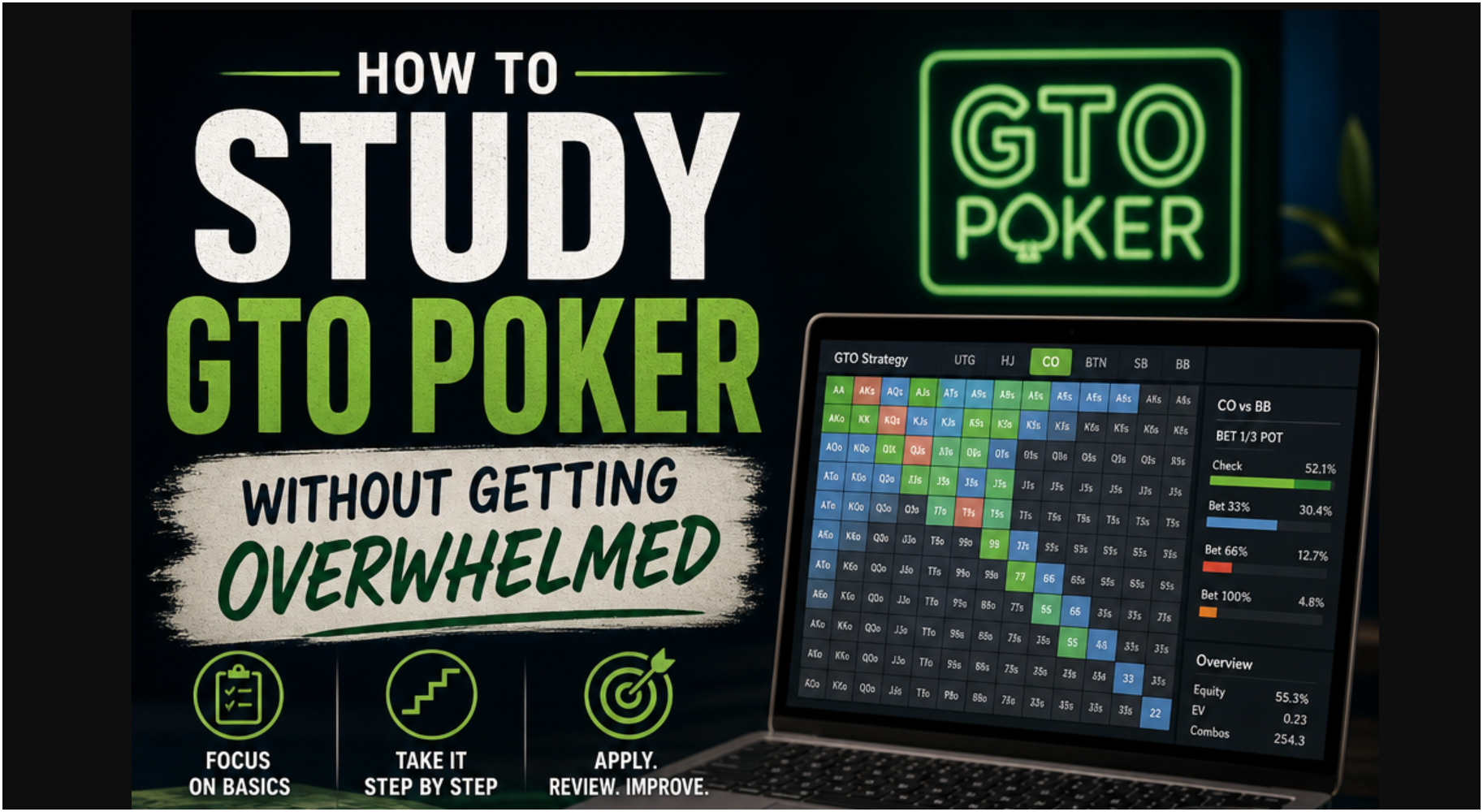
The easiest way to study these spots is with Best Poker Study Tools in 2026: GTO Software, Trainers, Solvers. Their chart-style study workflow makes overcalling patterns easier to spot and correct while you compare baseline ranges against your own pool assumptions.
If you want to see this issue in a more practical context, the same range discipline shows up in many real-game situations. For example, understanding spots that drive win rates at 25NL 6-max can help you identify where loose preflop calls are hurting your overall results before the flop even arrives.
A useful routine is to review one preflop node at a time. Compare your actual continue frequency with the solver or chart. Then label every marginal call as one of three things: a clear continue, a mix, or a clear fold. That simple process can expose how often you are defending just because a hand feels connected rather than because it truly belongs in the range.
Over time, the leaks become easier to see. You begin to recognize the spots where you are calling because the hand is familiar, not because it is profitable. That awareness alone can significantly improve your preflop discipline.
How to think about marginal hands without overcalling
Marginal hands create the most confusion because they sit near the border between continue and fold. The trick is to evaluate them through range interaction, not emotion. Ask whether the hand blocks villain’s value, whether it can improve on a variety of boards, and whether it performs well against the sizes you actually face. If the answer is only “sometimes,” the hand is often a mix rather than an automatic call.
This is especially important when a hand has appeal for the wrong reasons. A suited king or suited queen can look sturdy, but if it runs into stronger versions of the same shape, the actual realization is worse than it first appears. A small pair can look safe, but in some configurations it struggles to realize enough value unless stacks are deep and ranges are wide.
That is why strong players do not simply defend by category. They defend by combination quality. The difference between a good and bad call may be tiny in theory, but in practice it determines whether your range stays cohesive or becomes a collection of hands that are easy to pressure.
One of the simplest ways to improve is to compare your continue range against a solver and note where the exact phrase calling too much in poker applies in practice. Those are the spots where your intuition and the math are usually drifting apart.
Putting the leak into population context
In many pools, people are not only calling too much. They are calling in the wrong places. Some players overdefend versus opens, then become too passive versus 3-bets. Others do the opposite: they 3-bet light but still call too wide when they face resistance. Either way, the pattern creates a range that is difficult to navigate and easy to target.
Population tendencies matter because they affect how much value your continues actually have. If opponents are under-bluffing, loose bluff-catch-heavy calls become worse. If opponents are overfolding, some hands that would normally be indifferent can become better as pressure points. But even then, the baseline structure must be sound first.
That is where a balanced framework helps. Start from a solid theory-backed range, then adjust only when you have a good reason. If you skip the baseline and build your strategy around feelings, you will probably keep calling too much in poker without realizing where the extra frequency is coming from.
Against tougher pools, this gets even more important. Opponents who understand range pressure can quickly punish weak continues, especially when your range is capped or dominated. A disciplined response does not mean never calling; it means calling in the places where your range still functions well. That is the difference between a stable strategy and a leaky one.
The Bottom Line
Most players do not need to call more. They need to call better.
Better GTO calling ranges protect you from domination, improve equity realization, and keep your range structurally sound. If your default is to see flops with too many hands, you’re probably leaking EV long before the flop even arrives.
Study the charts. Tighten the calls. And stop treating every marginal spot like a license to defend. The more selective your preflop decisions become, the easier your postflop game will be.
That is the real value of disciplined preflop work: fewer weak continues, fewer dominated holdings, and more hands that actually deserve to be in the pot.
With a better framework, calling too much in poker stops being an invisible habit and becomes a fixable range-construction problem.